How to Make a Homeschool High School Transcript
A homeschool transcript sounds official and intimidating. It is one or two pages: courses, grades, credits, a GPA and your signature. Colleges accept parent-issued transcripts every admissions cycle, from state universities to the most selective schools. Nothing about it requires accreditation, permission or special software.
In a hurry? Our free homeschool transcript template and generator builds one in your browser. Enter courses, grades and credits, and it works out the GPA and gives you a print-ready PDF. Free, and no account needed.
What belongs on the page
- Student and school identity. The student’s name and date of birth, plus your homeschool’s name and address. Yes, give it a name. It goes in the header.
- Every course, grades 9 to 12. With the grade earned and the year taken.
- Credits per course, and a total.
- GPA, with the scale stated. A number with no scale beside it cannot be interpreted.
- Graduation date and your signature. Actual or expected. The signature is what makes it an issued document.
Assigning credits
The working convention is that a full-year course is one credit, roughly 120 to 180 hours of work, and a semester course is half a credit.
Textbook-based courses can simply follow the book. Finishing a standard high school biology text is a credit, and you do not need to count the hours to justify it.
For interest-led or self-designed courses, count hours instead. This is also how you legitimately award credit for the things homeschooling is good at: a serious year of competitive robotics, a part-time job in a veterinary practice, four hundred hours of ceramics.
Colleges generally expect somewhere around 24 credits across four years, with the core subjects represented most years.
How to calculate homeschool GPA
Convert each grade to points, multiply by the course’s credits to get quality points, add those up, and divide by total credits. The formula is not the confusing part. The half-credit course is.
| Course | Grade | Points | Credits | Quality |
|---|---|---|---|---|
| English 10 | A | 4.0 | 1.0 | 4.0 |
| Geometry | B+ | 3.3 | 1.0 | 3.3 |
| Biology | A- | 3.7 | 1.0 | 3.7 |
| World History | A | 4.0 | 1.0 | 4.0 |
| Spanish II | B+ | 3.3 | 1.0 | 3.3 |
| Studio Art | A | 4.0 | 0.5 | 2.0 |
| Year total | 5.5 | 20.3 |
On the standard unweighted 4.0 scale: A is 4.0, A- 3.7, B+ 3.3, B 3.0, B- 2.7, C+ 2.3, C 2.0, and so on down. If you prefer to skip plus-and-minus grades entirely, that is a perfectly defensible choice and makes the arithmetic simpler.
A cumulative GPA is the same calculation run across all four years at once, not the average of four yearly GPAs. Those two produce different numbers whenever the credit loads differ.
Weighted or unweighted
Weighting adds a point for honors or AP work, so an A in AP Biology scores 5.0 rather than 4.0. It is legitimate, and it is also the thing most likely to make an admissions officer squint at a parent-issued transcript.
Safest approach: show the unweighted GPA as the headline number, and if you want to weight, show both side by side with the scale for each. The goal is a number nobody has to guess at.
Grading your own child honestly
This is the part parents find genuinely uncomfortable, and the fear of looking generous makes some families grade harshly, which serves nobody.
Grade from real work: tests, papers, projects and lab reports, averaged by subject, the same way a school would. If your student redid work until it was excellent, that is mastery learning and the A is earned. Write down the policy once and apply it consistently.
An outside reference point helps more than anything else here. Standardized test scores, a dual enrollment grade, or an AP result all corroborate your grading, which is precisely what a skeptical reader is looking for.
Two accepted layouts
Group courses by year, freshman through senior, or by subject, with all math together and all science together. Admissions offices read both every day.
By year is the conventional choice and shows progression. By subject often flatters a student whose coursework did not follow a traditional sequence, or who took four years of one subject and one of another.
What colleges are actually checking
Not the font. They are checking internal consistency: that credits add up, that a GPA scale is stated, that grades align plausibly with test scores and essays, and that course titles mean something recognizable.
Course descriptions are the companion document worth having ready. A short paragraph per course naming the texts used and topics covered. Some colleges ask, most do not, and having them on file turns a stressful request into an attachment.
Call it “Precalculus” rather than “Advanced Math Studies”. Invented-sounding titles are the single easiest thing to get wrong on an otherwise good transcript.
What a course description looks like
Shorter than people fear. Three or four sentences per course, naming what was used and what was covered. Something like:
Biology (1 credit, 2025-26). Completed Miller and Levine Biology with the accompanying lab manual. Topics included cell structure, genetics, evolution, ecology and human body systems. Twelve labs completed with written reports, including dissection and a term-long ecology field study. Assessment by unit tests and lab reports; grade reflects the average across both.
Write them at the end of each course while it is fresh, not in senior year for all twenty-four at once. That is twenty minutes a term against a lost weekend later.
If you did not keep records for the early years
Common, fixable, and not a reason to panic. Plenty of families start taking this seriously in eleventh grade.
Reconstruct from what physically exists: the books on the shelf, the curriculum you bought, photos, library history, old workbooks, the co-op classes you paid for. A year of a math program you can hold in your hand is a credit you can defend.
Assign grades honestly from whatever evidence survives, and where you genuinely cannot, a pass mark or a mastery notation is more honest than an invented A. Then start recording properly from today, and lean harder on outside verification such as test scores or a dual enrollment course to corroborate the earlier years.
Where the records come from
The transcript is trivial if the four years behind it were recorded as they happened, and miserable if it has to be reconstructed from memory in the September of senior year.
That is the entire argument for keeping records from ninth grade rather than twelfth. What you need is small: course title, provider, hours or text completed, and a grade, captured once per term. Our guide to homeschool record keeping covers the rest.
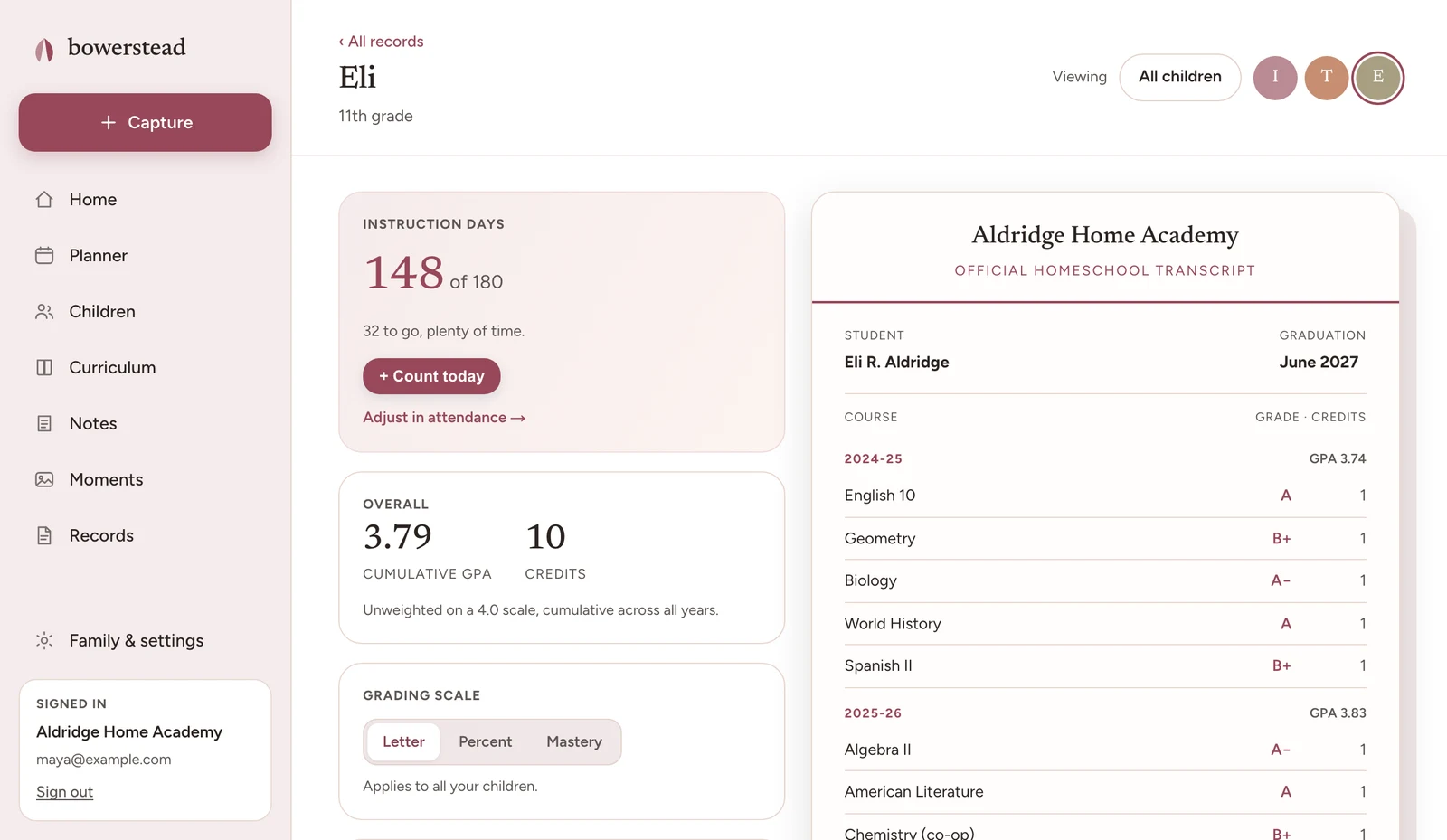
Bowerstead tracks each child’s subjects, work and progress through the year and produces a clean, print-ready transcript PDF from what you already captured, with the GPA worked out rather than hand-calculated. $9 a month or $79 a year, with a 30-day money-back guarantee. Get started.
A note for UK families
None of this applies directly. UK universities admit on exam results rather than a school-issued transcript, so a home-educating family sits GCSEs and A levels as private candidates and the certificates do the job the transcript does here.
If your child is applying to US universities from the UK, you will need something transcript-shaped alongside those results, and the format on this page is what they expect.
Frequently asked questions
Do colleges accept homeschool transcripts? Yes, routinely. A parent-issued transcript is the standard document for a homeschool applicant and no accreditation is required. Admissions offices process these every cycle.
Is there a free printable homeschool transcript template? Yes, ours is at bowerstead.com/transcript. It calculates the GPA as you type and downloads a print-ready PDF, with no account and no payment.
When should I start building it? Ninth grade. Not because the document is needed then, but because the four years of detail it draws on are impossible to recall accurately later.
How do I handle co-op or community college courses? List them like any other course and note the provider. Dual enrollment also generates an official college transcript, which the student requests and sends separately, and that one carries real weight.
What if my child is not going to college? Make one anyway. Employers, the military, apprenticeships, trade programs and community colleges all ask for proof of secondary education, and plans change between sixteen and twenty more often than not. It is an afternoon of work now against a genuinely hard reconstruction later.
Can I issue a diploma too? In most states the parent issues it and it is valid. The transcript is the document that actually gets read; the diploma is mostly for the wall and for employers who ask.
Free Printable Templates
A four-year transcript and a year-long attendance log, ready to print.
We email you a copy plus occasional record keeping advice. Unsubscribe from any email in one click. See our privacy policy.