Homeschool Record Keeping: What to Track and For How Long
Record keeping generates more low-grade dread than any other part of homeschooling, and needs less actual work than almost any of it. The families who find it easy all do the same thing: they capture a little as they go instead of reconstructing a lot at the end. Here is what to keep, how long to keep it, and what you can let go of entirely.
Why records matter even where nothing is required
Your state’s law sets the floor. Some states require attendance counts or portfolio reviews, others ask for nothing at all, and the second group is where families most often keep nothing and later regret it.
Records earn their keep well beyond compliance. They answer an evaluator. They smooth a move to a stricter state. They ease a child’s return to school, where a district will place your child using whatever you can show them. And from ninth grade they quietly become the transcript.
There is a private reason too. Records answer the ten o’clock question of whether you are doing enough. You usually are, and on a bad week the record is the only thing that can prove it to you.
What to keep, and for how long
The second half of that question is the one nobody answers, because the answer is not a single number.
| Record | Why it matters | Keep it |
|---|---|---|
| Attendance | Compliance, where your state counts instruction days | A year or two past the review window |
| Subjects and curriculum | Shows the year was actually covered | A year or two, then retire it |
| Work samples | Portfolio reviews, and school placement if you return | A few per subject per term, kept two years |
| Progress notes and grades | Report cards, and the transcript from grade 9 | Permanently from grade 9 |
| Courses, credits and grades | The transcript itself | Permanently |
| Reading lists | Course descriptions colleges sometimes ask for | Permanently from grade 9 |
| Test or evaluation results | Compliance, and corroboration of your own grading | Permanently |
| Receipts and expenses | ESA or voucher audits, and any state tax credit | As long as the tax or program rules say |
If you take one thing from this page, take the split. Elementary records can retire a year or two after the year ends, once any review window has closed. High school records are permanent, and treating them that way from ninth grade is the single highest-value habit in homeschooling paperwork.
The seven things worth tracking
Attendance
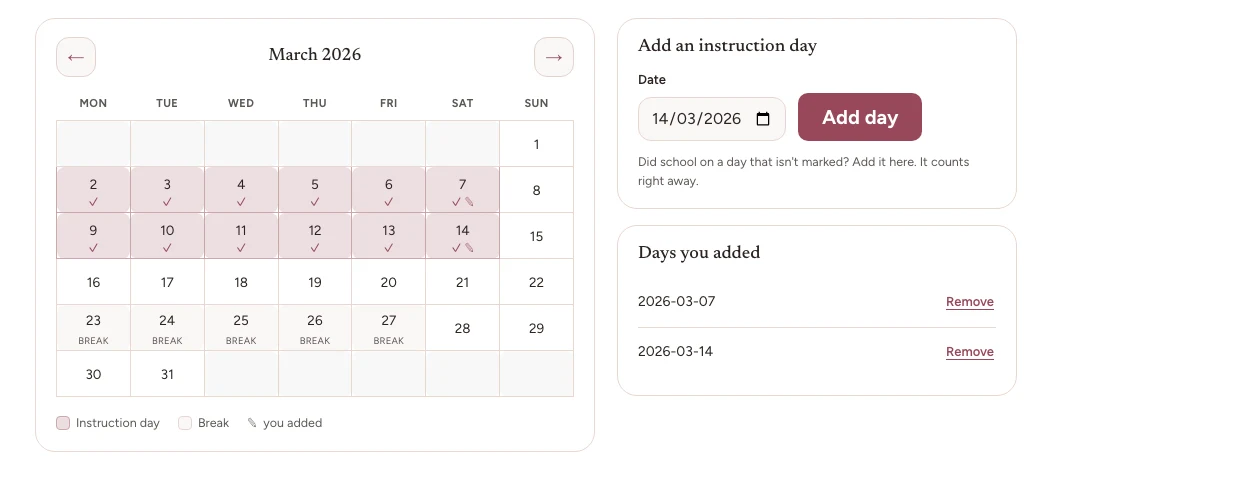
A count of instruction days, where your state requires one. This is the only item on the list that is genuinely a chore, because it has to happen daily to be accurate.
Any homeschool attendance tracker works, including a wall calendar with crosses on it. What matters is that it gets marked the same day rather than reconstructed in May, because reconstructed attendance is a guess wearing a number.
Subjects and curriculum
What you covered and what you used. One line per subject per term is enough, and it is what turns into course descriptions later.
Work samples
A few pieces per subject per term, in any form. A worksheet, a photo of a project, a recording of a narration, a scan of a page of writing.
Date them. An undated sample proves far less than a dated one, and dating is the entire difference between a portfolio and a box.
Progress notes and grades
In whatever form suits the child’s age. Below middle school a sentence of observation is worth more than a letter. From ninth grade, grades, because they are heading somewhere.
Reading lists
Almost free to keep and disproportionately valuable later. A running list of what was read becomes high school course descriptions with nearly no extra work.
High school courses and credits
From ninth grade: course title, provider, hours or text completed, and the grade. That is the whole transcript, captured once per term instead of reconstructed in senior year. Our guide to making a homeschool transcript covers what it feeds.
Receipts and expenses
Only if you use an ESA, a voucher or a state tax credit, or simply want clean records. Those programs run on documentation, and families lose reimbursements to lost receipts far more often than to rejected purchases.
What a homeschool portfolio actually is
The word sounds like a craft project and it is not. A homeschool portfolio is simply a dated, organized selection of the above, assembled so somebody else can look through it and see that a year happened.
In the states that require a portfolio review, an evaluator typically wants a log of what was covered, samples showing work near the start and near the end of the year so growth is visible, and any test results. That is it.
- Organize by subject, then by date. An evaluator reads it that way, and it takes ten minutes if the pieces are already dated.
- Include something from the start and the end. Growth is what is being assessed, and two dated samples show it better than twenty undated ones.
- Do not curate out the ordinary. A portfolio of only best work looks staged. A normal one is more convincing.
Evidence counts in any form
A record does not have to look like school to count. A photo of the model bridge, a note about the conversation on a walk, a video of a recitation: these document learning as truthfully as a graded worksheet.
Capture in the form the learning actually took and the record stays honest. Trying to convert a hands-on year into worksheets after the fact is how families end up believing they did less than they did.
State compliance without the dread
Most of the anxiety here is fear of an invisible requirement rather than a real one. Read your state’s homeschool law once, write down the two or three things it actually asks for, and keep that note where you will see it.
Nearly every state’s requirements fit on a single page, and once they are visible they are usually smaller than the dread. Our guide to how homeschooling works covers the four things a state can ask for and how they vary.
One thing worth doing on the day you start: save a copy of whatever you filed, and the confirmation. It is the cheapest insurance in homeschooling and the thing people most often cannot find later.
The habit that makes it effortless
One organized place beats a shoebox, and thirty seconds in the moment beats an afternoon of year-end archaeology.
The manual version genuinely works: a notebook for attendance, a folder per child per year for samples, a running document for subjects and reading. Thousands of families do exactly this and never need anything else. The only real failure mode is leaving it all to the end of term.
Bowerstead is built around the same principle, minus the shoebox. Capture what happened as it happens, and attendance, subject records, reports and eventually the transcript assemble themselves from it. No overdue flags, no streaks to break and no red badge counting what you missed, because a homeschool is not a to-do list. A digital homeschool plannershould show you the year you had, not the year you planned.
Being straight about the edges: it does not store receipts and has no expense log, so an ESA folder stays yours to keep. $9 a month or $79 a year for the whole family, with a 30-day money-back guarantee. Get started.
How this works in the UK
There is no attendance requirement and no register to keep, because elective home education has no minimum days and no curriculum to report against.
What British families keep is a portfolio, and the reason differs: a local authority may make informal enquiries about whether a suitable education is happening, and a dated folder of work plus a short written summary per term answers that in one meeting. Nothing obliges you to produce it, but having it is far easier than arguing about whether you should.
Frequently asked questions
What records am I legally required to keep? It varies by state, most commonly attendance and subjects, sometimes assessment results. Read your state’s homeschool law directly; it is shorter than you fear, and it is the only source that actually answers this.
How long should I keep homeschool records? Elementary records can retire a year or two after the year ends, once any review window has closed. High school records are permanent, because colleges, employers and licensing boards ask for them years later.
Do I need work samples? Not everywhere, but a few per subject per term makes any portfolio review a formality and shows growth in a way numbers cannot. Dating them is what makes them worth keeping at all.
What if I am starting mid-year with no records? Start today rather than trying to rebuild the autumn. Note roughly what was covered, keep anything physical that survives, and record properly from here. A partial year recorded honestly is worth more than a full one invented.
Paper or digital? Whichever you will actually keep up. Paper is fine and free. Digital wins mainly on two things: finding something four years later, and turning records into a report or a transcript without retyping them.
Free Printable Templates
A four-year transcript and a year-long attendance log, ready to print.
We email you a copy plus occasional record keeping advice. Unsubscribe from any email in one click. See our privacy policy.