How to Create a Homeschool Schedule That Actually Works
The schedules that survive past October are never the prettiest ones. They are the ones with the fewest promises in them. Most homeschool timetables fail for the same reason: they are built out of clock times, and clock times break the first week something goes wrong. Here is how to build one around how children actually learn and how families actually live.
Start with honest hours
A school day is mostly not instruction. It is lining up, waiting, transitions and crowd management. One to one at home, the real numbers are much smaller.
- Kindergarten to 2nd grade. One to two focused hours, usually finished before lunch.
- 3rd to 5th grade. Two to three hours.
- Middle school. Three to four hours, some of it independent.
- High school. Four to five hours, mostly independent by the end.
If your seven year old is done by lunch, nothing is wrong. That is the system working, and a typical homeschool day genuinely is shorter than a school one.
Order beats clock time
The single most useful change most families make is to stop assigning times and start assigning sequence. Children settle because they know what comes next, not because it begins at 9:00 sharp.
A sequence survives a late start, a bad night and a dentist appointment. A timetable records all three as failures, and after enough of those you conclude you are bad at this, when what happened is that you wrote down the wrong kind of plan.
Block scheduling for the things that need daily contact
A block schedule gives a subject a fixed, protected slot. Math happens every school day, first, before anything can eat the morning.
Block the things that genuinely decay without daily contact, which is usually math and reading, and no more than that. Blocking everything recreates the timetable you were trying to escape.
Block scheduling in a homeschool has a second meaning worth knowing: at high school age, some families run one subject intensively for a term rather than five subjects thinly for a year. That works well for history, literature and lab sciences, and badly for math and languages, which need frequency more than depth.
Loop scheduling for everything else
A loop is a rotating list with no fixed days. You keep one slot in the day for it, and whenever that slot arrives you do the next thing on the list.
| Mon | Tue | Wed | Thu | Fri | |
|---|---|---|---|---|---|
| Week 1 | Science | History | Art | Music | Geog |
| Week 2 | Science | History | None | Art | Music |
| Week 3 | Geog | Science | History | Art | Music |
This is the piece that makes a homeschool schedule durable. Science, history, art, music and geography do not need to happen on particular days, and pretending they do is what generates the guilt.
Two rules keep a loop honest. Do not put anything on it that genuinely needs a fixed day, such as a co-op class, and if something reaches the front of the loop repeatedly and keeps getting skipped, take it off the loop rather than lying to yourself about it.
If you want to lay this out rather than read about it, our free homeschool schedule maker builds exactly this: blocks in order, a loop underneath, and a check of your heaviest day against the honest hours above. It prints on one page and costs nothing.
A sample day, elementary age
- Read-aloud or morning basket, 20 minutes
- Math, 30 minutes, blocked
- Language arts, 30 minutes, blocked
- Break, outdoors if at all possible
- Next subject on the loop, 30 minutes
- Independent reading, 20 minutes
Roughly two focused hours, and no times attached to any of it. That is a complete elementary day, and the afternoon belongs to the child.
A sample week that survives contact
Four teaching days and one deliberately light one is the shape most families converge on after a year.
- Monday to Thursday. Blocked math and language arts, one loop slot, one outing or activity.
- Friday. Light on purpose. Catch-up, a project, a museum, or genuinely nothing.
- One morning unassigned. Not a day off. Margin, which is what absorbs the dentist.
Building the plan around four days rather than five means an interruption costs you slack instead of putting you behind. Families who plan five full days spend the year feeling like they are failing at a plan that was never achievable.
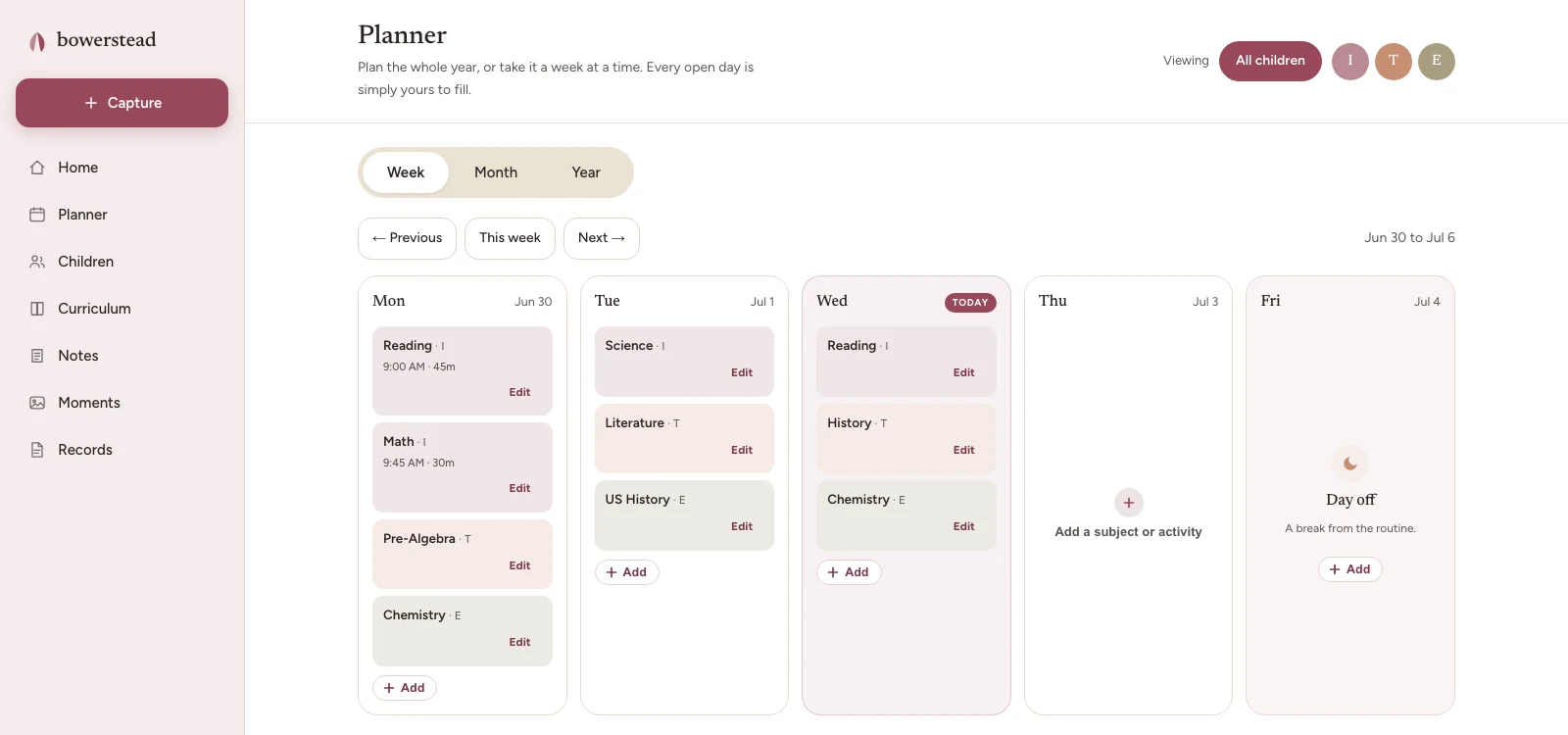
Scheduling several children at once
This is the part that actually defeats people, and it is not solved by a better timetable. It is solved by teaching together wherever the subject allows.
History, science, art, music, geography and read-alouds all work across a wide age spread. Everyone hears the same content and each child responds at their own level: the six year old narrates a sentence, the twelve year old writes a page. Only math and reading genuinely have to be individual.
That reframes the whole problem. Instead of running three separate school days in parallel, you run one shared block plus a short one-to-one slot per child.
- Start together. The shared loop subject first, while everyone is fresh and in the same room.
- Stagger the one-to-one slots. Teach the youngest first, since they cannot work unsupervised. The older ones do independent work while they wait, not the other way round.
- Give the toddler a job. A drawer of things only opened during math buys twenty minutes and costs nothing.
- Let older children finish alone. From about eleven, a written list for the day is better than your presence, and it teaches the thing they will actually need later.
Schedule the margin too
The families still homeschooling happily in May are the ones whose plan assumed interruptions rather than treating each as a failure.
Leave one morning a week unassigned. Keep Fridays light. Plan thirty-six weeks of content into a forty-week year, so illness and travel land in space you already allowed for. A plan you did not follow is information, not a verdict.
When the schedule stops working
It will, two or three times a year, and the useful response is diagnostic rather than moral.
- Same subject skipped repeatedly? The material is wrong, or it is in the wrong place in the day. Move it earlier before you replace it.
- Mornings collapsing generally? You are almost certainly starting too late or planning too much. Cut a third.
- Everything fine but you are exhausted? That is a margin problem, not a scheduling one, and adding structure will make it worse.
Rewrite the schedule two or three times a year on purpose. A plan built in August for a child who has since turned nine is not supposed to still fit.
Plan forward, record what happened
A schedule has two halves, the intention and the reality, and most homeschool schedule template downloads only handle the first. The gap between them is where the guilt lives, and it is also where the actual evidence of your year is.
Bowerstead keeps both without shaming the difference. You sketch the year, capture what actually happened each day, and the record leads with what was done. No overdue flags and no streaks to break, because a homeschool is not a to-do list. $9 a month or $79 a year, with a 30-day money-back guarantee. Get started.
What you captured is also what your state may ask for later. Our guide to homeschool record keeping covers which parts are worth keeping and for how long.
Frequently asked questions
How many days a week should we homeschool? Four or five is typical, and plenty of families school year-round at a gentler pace instead. Check whether your state counts instruction days, and beyond that choose what you can sustain in February rather than what looks right in August.
What time should we start? Whenever your child focuses best, which for most is mid-morning. Consistency of order beats earliness every time, and a 9:00 start you keep is worth more than an 8:00 start you resent.
What is the difference between block and loop scheduling? A block gives a subject a fixed slot every day. A loop is a rotating list with no fixed days that simply continues where it stopped. Most families block math and reading and loop everything else.
Do we need a schedule at all? A loose rhythm, yes. It tells children what to expect and tells you the essentials are covered. A minute-by-minute timetable, almost never, and the families who build one usually abandon it by half term.
Should we school year-round? It suits families who want shorter days, and it removes the long summer slide that costs several weeks of review every September. The trade is that you never get a clean stop, which some parents need more than the children do. A common middle path is six weeks on, one week off, all year.
How many weeks should a homeschool year be? Plan about thirty-six weeks of content and spread it across forty, so illness, travel and bad weeks land in space you already allowed for. If your state counts instruction days, check the number before you build the calendar rather than after.
New to all of this? Start with our step-by-step guide to starting homeschooling, which covers the order the first decisions go in.
Free Printable Templates
A four-year transcript and a year-long attendance log, ready to print.
We email you a copy plus occasional record keeping advice. Unsubscribe from any email in one click. See our privacy policy.