How to Start Homeschooling: A Calm Step-by-Step Guide
Deciding to homeschool is the hard part. Starting is a short list of concrete steps, none of which require a teaching degree, a classroom or a finished plan. What almost every beginner homeschool guide leaves out is that the order matters more than the list, because most of these steps go wrong by being done too early. Here is the whole path, in sequence.
The whole sequence, in order
| Step | Why here |
|---|---|
| 1. Read your state's law | Everything below depends on what it asks. Fifteen minutes now removes most of the anxiety. |
| 2. File whatever it requires | Some states have a window. Missing it can cost the year rather than a place in a queue. |
| 3. Withdraw in writing | After filing, never before. Unexplained absence starts a truancy process that is tedious to unwind. |
| 4. Set up how you will record | Cheapest before there is anything to record. Reconstructing a term from memory is the alternative. |
| 5. Deschool, if they need it | A child leaving a bad situation cannot start until they have stopped. Weeks, not days. |
| 6. Buy math and language arts only | You do not yet know what your child needs. The expensive mistake is the unused purchase. |
| 7. Choose a rhythm, not a timetable | Which days, what order, when you stop. Clock times break in week two. |
| 8. Book one social commitment | It stops happening by default the day you withdraw, and nothing replaces it accidentally. |
Only the first two have deadlines. Everything after them can move to suit your family, which is worth knowing when the list looks like eight things you have to do this week.
Step 1: Read your state’s law
Homeschooling is legal in all fifty states. What differs is paperwork. Before anything else, find your state department of education’s homeschool page and answer three questions.
- Do I need to notify anyone, and by when?
- What am I required to record: days of instruction, hours, subjects?
- Is there an assessment: a test, an evaluation, a portfolio?
Write the answers down somewhere you will find them again. Most of the anxiety new homeschoolers carry is fear of an invisible requirement. Once the requirements are visible they are usually small.
If the law looks ambiguous, or a district tells you something that contradicts it, that is what a homeschool legal defense organization is for. Membership is inexpensive and the main thing you are buying is someone to answer that letter.
Step 2: File, then withdraw
In that order. Establish the new arrangement first, then tell the school in writing that your child is leaving and where records should go.
Do not simply stop sending them. Unexplained absence starts a truancy process, and unwinding one is far more work than the letter that would have prevented it. Keep a copy of everything you send.
If your child has never been enrolled, there is usually nothing to withdraw from and you begin once any notice is filed. There is no ceremony to wait for.
Step 3: Deschooling, and why to bother
If your child is leaving a situation that was hurting them, do not start school at home on Monday. Deschooling is a deliberate pause: no curriculum, no lessons, reading and museums and sleep and being bored.
The point is that a child who has been bracing for months cannot learn until they have stopped bracing. Starting academics into that produces a fight you will mistake for evidence that homeschooling is not working.
A common rule of thumb is a month for each year spent in school, which most families find far too long and shorten. Two to six weeks is the usual landing point. Watch for curiosity returning: asking questions, picking up a book unprompted, starting a project nobody assigned.
Adults need it too. If you spent years measuring your child against a grade level, some of what you are deschooling is your own expectations.
Step 4: Set up records before you need them
This lands here rather than at the end because it is nearly free now and expensive later. At minimum, decide where you will keep:
- Days of instruction, if your state counts them
- Subjects covered and the materials you used
- Progress notes or grades, in whatever form suits your child
- A few samples of real work each term
Even in a state that asks for nothing, this is what answers an evaluator, smooths a move, eases a return to school and becomes the high school transcript later. Our guide to homeschool record keeping covers what to keep and for how long.
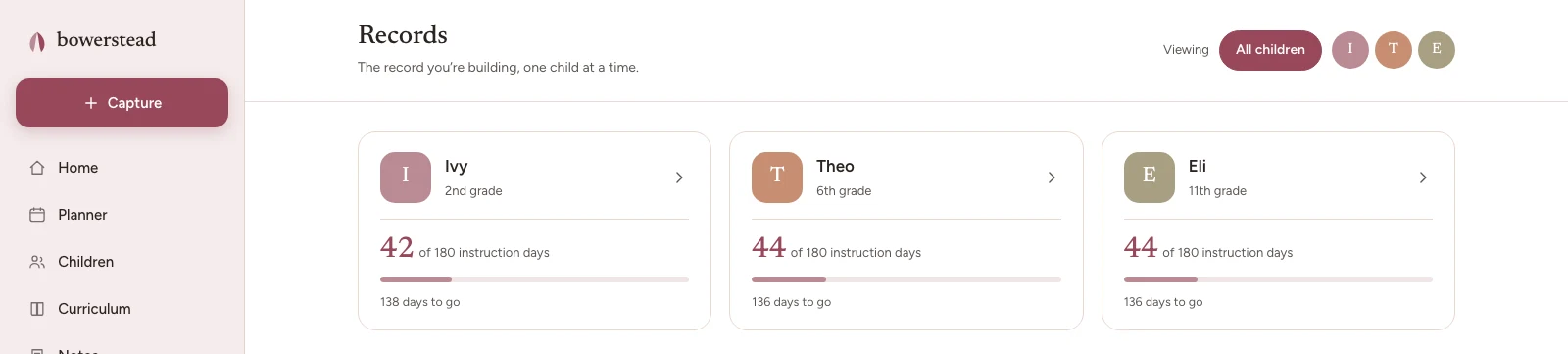
A digital homeschool planner exists to make this a few seconds a day rather than a Sunday evening: note what happened, and attendance, subject records and reports assemble themselves. No streaks, no overdue flags, no red badge counting what you missed. $9 a month or $79 a year, with a 30-day money-back guarantee. Get started.
Step 5: Buy far less than you want to
Buy math and language arts properly. Take everything else from the library and free curricula until the year proves you need more.
You do not yet know how this child learns, and the expensive mistake is never the costly program, it is the unused one. Our guide to choosing a homeschool curriculum covers how to narrow it down, and what it costs has honest numbers.
Step 6: Build a rhythm, not a timetable
One-to-one learning is dense. Young children often need one to two focused hours a day, older students three to five, and stretching the day to resemble school helps nobody.
What keeps a homeschool running is a predictable order rather than clock times: which days are school days, what usually comes first, when you stop. Clock times break in week two and take your confidence with them. Our guide to building a homeschool schedule goes deeper.
Step 7: Put one social thing in the week
Daily social contact stops happening automatically the day you withdraw, and nothing replaces it accidentally. One regular commitment where the same children turn up repeatedly beats a scatter of one-off events.
A co-op is the obvious route, but a sports team, scouts, a choir or a standing park day all do the same job.
What you do not need
Roughly half of what beginners buy, build or worry about is optional. Worth saying plainly, because the overwhelm is nearly always caused by this list rather than the real one.
- A schoolroom. A kitchen table is the most common classroom in the country. Desks and wall charts are decoration.
- To teach every subject yourself. Curricula, online courses, co-ops, tutors and a grandparent who covers French all count as your child being taught.
- The whole year planned. Plan the first six weeks properly and leave the rest deliberately blank.
- To match a grade level. Grade levels are an administrative convenience for grouping thirty children. With one child they are close to meaningless.
- To replicate a school day. Six hours at home is not a higher standard. It is mostly waiting, which is the thing you just removed.
What the first term actually looks like
Wobbly. Everyone’s is. You will over-plan the first fortnight, abandon something in October, and spend a week convinced you have ruined your child’s education.
That is the process working, not failing. The first term is for finding out how this child learns, and a curriculum swap in November is a course correction rather than a verdict.
Two things worth deciding in advance: a date about six months out when you will review honestly, and what you would want to see by then. Both are much easier to judge if you have been writing down what happened.
If you are starting in the UK
The sequence is the same but step two differs. In England you deregister by writing to the head teacher, and the school must remove your child from the roll. No permission is required unless your child attends a special school under a local authority placement.
Scotland is the exception: you generally need local authority consent to withdraw from a state school. Nowhere in the UK is there a curriculum or testing requirement for elective home education.
Frequently asked questions
Do I need to be a certified teacher? No state requires a teaching certificate to homeschool your own child. A few ask for a high school diploma or GED from the teaching parent, and that is the extent of it.
Can we start mid-year? Yes. File whatever notice your state requires and begin. Learning does not care what month it is, and mid-year is when a lot of families start, usually because something at school stopped being survivable.
How long should we deschool? Two to six weeks suits most families. Longer if school was genuinely damaging, shorter or not at all if your child was never enrolled. Watch for curiosity coming back rather than counting days.
What if I get it wrong at first? Everyone does. The first term is diagnostic, not definitive, and nothing you choose in September is binding in January. Children are markedly harder to ruin than the internet suggests.
What does the first week actually need to contain? Read your state’s law, file the notice if one is needed, and choose which days are school days. That is genuinely enough to have started.
Free Printable Templates
A four-year transcript and a year-long attendance log, ready to print.
We email you a copy plus occasional record keeping advice. Unsubscribe from any email in one click. See our privacy policy.