How Does Homeschooling Work? A Plain Answer
If you have run this search a few times already, you have probably come away with more noise than answer. Half the results are selling a curriculum and the other half are somebody’s life story. So here is the plain version: homeschooling works because your state lets a parent, rather than a school, be the person responsible for a child’s education. You tell the state you are doing it, if your state asks. You teach. You keep records. That is the shape of it.
What homeschooling actually is
The short answer to what is homeschooling: parent-directed education that happens outside a school system. You choose the materials, you set the pace, and you are the one accountable for progress.
That last part is the real definition. Homeschooling is not about the building, and it does not mean recreating a classroom in your kitchen or teaching every subject yourself from memory. It is about who holds responsibility. Families use purchased curricula, online courses, tutors, co-ops, community classes and the library, in whatever mix suits the child. The parent’s job is closer to director than lecturer.
Homeschooling, online school and hybrid are not the same thing
These three get mixed up constantly, and the difference is legal rather than cosmetic.
- Homeschooling. You are legally responsible. You pick the curriculum. Your state may ask you to notify, test or keep records.
- Online public school. Your child is still enrolled in a public school. The school is responsible, there is a teacher of record, and attendance and state testing are mandatory. This is not homeschooling, even though it happens at your kitchen table.
- Hybrid or university-model school. Your child attends a campus two or three days a week and learns at home the rest. The legal status varies by program, so check which set of rules you are under.
What it is called outside the US
If you are reading from Britain, the term you want is elective home education, usually shortened to EHE. Home education UK guidance sits with your local authority rather than a state department, and a few practical things differ:
- In England and Wales the duty comes from Section 7 of the Education Act 1996: parents must provide an efficient, full-time education suitable to the child’s age, ability and aptitude.
- You are not required to follow the National Curriculum, keep school hours, or enter your child for exams.
- If your child is already on a school roll in England, you deregister in writing. Scotland is different: you generally need local authority consent to withdraw from a state school.
- Instead of US-style grades you will see Key Stages, and many families keep a portfolio of work to show at an informal local authority visit.
The daily reality is very similar on both sides of the Atlantic. It is the paperwork vocabulary that changes.
Who is allowed to homeschool
In the United States, homeschooling is legal in all fifty states and has been settled law since the early 1990s. More than three million children are educated this way.
Do you need a teaching degree?
Almost certainly not. A small number of states have asked for a high school diploma or GED from the teaching parent, but no state requires a teaching credential to educate your own child.
What actually predicts a good year is more boring than a degree: consistency, materials that match the child, and a system for keeping track of what you did.
Working parents and single parents
Both homeschool successfully, in large numbers, because homeschooling takes far less clock time than school does. A classroom teacher spends most of the day on transitions, registers and repeating instructions to thirty children. One to one, you skip all of that.
State homeschool requirements: the four things you may be asked for
This is the part that causes the most anxiety, so let us make it concrete. State homeschool requirements vary enormously, but nearly all of them are assembled from the same four building blocks.
| What is asked | Low regulation | Moderate | High regulation |
|---|---|---|---|
| Notice of intent | Not required | Once a year | Once a year |
| Subjects or hours | Not specified | Often set | Set in law |
| Assessment | None | Sometimes | Test or portfolio |
| Records the state sees | None | None | Portfolio or samples |
1. Notice of intent
Some states want a short letter or online form saying you intend to homeschool, usually filed once a year. Some want nothing at all. A few ask you to operate under a private school filing instead, which is how homeschooling in California commonly works.
2. Subjects and instruction time
Many states list required subjects, typically some combination of reading, writing, math, science and social studies. Some also set a minimum number of instructional days or hours per year.
3. Assessment
This is where states differ most. Depending on where you live you may face standardized testing at certain grades, a portfolio review by a qualified evaluator, or no assessment requirement whatsoever.
4. Records
Even in a state that requires nothing, you will want records. Attendance, subjects covered, work samples and grades are the evidence that you did what you said you would do.
Taken together these sit on a spectrum. At the light end, a state like Texas asks for essentially nothing beyond covering basic subjects. In the middle, states ask you to file a notice each year. At the formal end, states like New York and Pennsylvania ask for annual paperwork, records and some form of assessment.
Rules change, and secondhand summaries in Facebook groups go stale fast. Read your own state department of education page directly, or a current state law summary from a homeschool legal organization, before you file anything. Your state’s requirements fit on a page, and reading that page is the real first step.
What a normal homeschool day looks like
Shorter than you expect. One-to-one teaching is dense: no registers, no transitions, no waiting for twenty-eight other children.
Realistic hours by age
These are working averages rather than rules:
- Ages 5 to 7 (K to 2nd grade). 60 to 90 minutes of formal work, spread across the morning.
- Ages 8 to 10 (3rd to 5th grade). Two to three hours.
- Ages 11 to 13 (middle school). Three to four hours.
- Ages 14 to 18 (high school). Four to six hours, increasingly self-directed.
If your seven year old is finished by half past ten, you have not failed. You have removed the overhead.
A sample weekday
- 9:00. Math. The hardest subject first, while attention is cheapest.
- 9:40. Movement break, outside if possible.
- 10:00. Language arts: reading, writing, spelling.
- 10:40. Read aloud together, snack.
- 11:15. Rotating subject. Science Monday and Wednesday, history Tuesday and Thursday, art Friday.
- 12:00. Lunch, then an afternoon for co-op, sport, library, errands, or nothing at all.
Some families follow a timetable, others work through a weekly list in whatever order the day allows. Both are normal. Our guide to creating a homeschool schedule goes deeper on finding a rhythm that holds.
Where the teaching actually comes from
Almost nobody teaches everything from scratch. You have four broad options, and most families end up mixing them.
- A curriculum in a box. One provider covers every subject with a daily plan. Highest structure, lowest decision fatigue, highest cost.
- Subject by subject. The best math program, the best writing program, and so on. More work up front, better fit for the child.
- Approach-led. Charlotte Mason, classical, unit studies or unschooling shape the whole rhythm rather than a single publisher.
- Free and library-based. Public domain and open curricula plus a library card. Costs almost nothing and works well in the early years.
The question is not whether you are qualified to teach calculus. It is whether you can find calculus for your teenager when the time comes, and you can. New homeschoolers consistently overbuy in year one: start with math and language arts done well, then add the rest once the rhythm holds. Our guide to choosing a homeschool curriculum covers how to narrow it down, and what homeschooling costs has the honest numbers.
How progress gets measured without report cards
School hands you a grade every quarter, and losing that feedback loop is genuinely unsettling at first. Replace it with three things.
- Evidence. A folder of dated work samples per subject, per term. Six pieces a year per subject is plenty.
- A checkpoint. Twice a year, sit with the work and ask: is this child further along than in September? That question is more useful than a letter grade.
- An outside signal, if you want one. An annual standardized test or an evaluator’s letter gives you a reference point, even in a state that does not require it.
The part nobody warns you about: record keeping
Teaching is the enjoyable part. Proving you taught is the part that quietly eats your Sunday evenings.
You will need attendance days, hours by subject, what was covered, work samples, grades, and eventually a high school transcript. Doing that in a notebook works until roughly February, when the notebook has a coffee ring on it and three weeks of gaps.
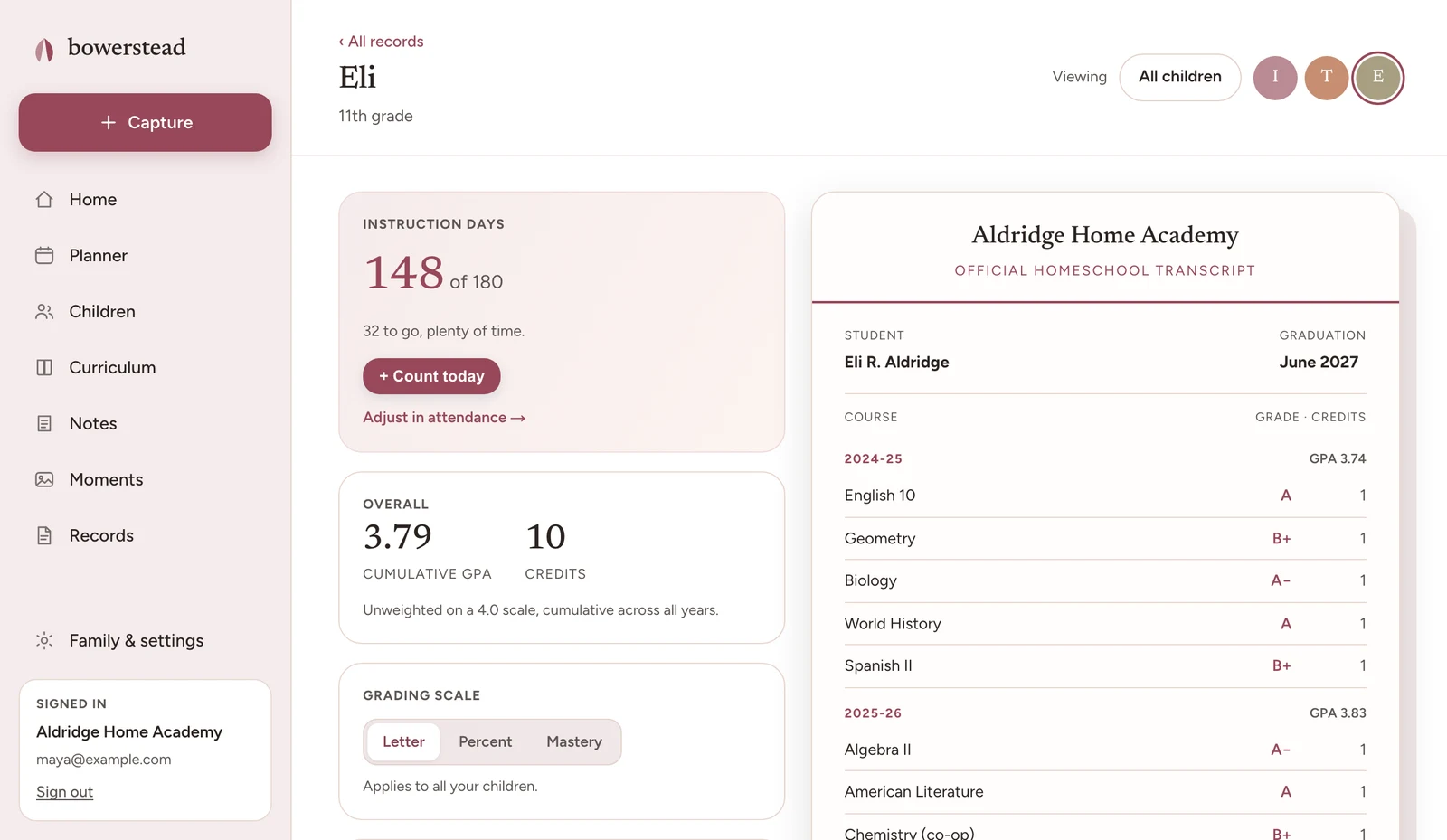
This is the friction Bowerstead was built to remove. It is a digital homeschool planner that turns the teaching you already did into the records you may be asked for. Log a lesson once and it counts toward attendance, subject hours and the child’s records at the same time. Build a schedule for the year instead of rewriting a planner page every Sunday. Produce a report card or a high school transcript from records you already entered, rather than reconstructing four years of history the week a college asks.
To be straight with you: a homeschool planner app keeps your records in a clean general format, and it is not legal advice. Confirming your own state’s rules stays your job. What it buys you is the hours back, and the certainty that if someone asks for evidence you can produce it in about ninety seconds. $9 a month or $79 a year, with a 30-day money-back guarantee. Get started. If you would rather see the manual version first, our guide to homeschool record keeping lays out what to track and for how long.
What about socialization?
The question every homeschooling parent is asked, and the one that worries new families least once they start. It is a scheduling problem rather than a homeschooling problem.
School provides social contact automatically. Homeschooling makes you put it on the calendar: co-ops, sports teams, scouts, church groups, music lessons, park days and neighbourhood friendships, with a wider mix of ages than a classroom offers. Two or three regular commitments a week is where most families settle. Aim for consistent groups where the same children show up repeatedly, rather than a scatter of one-off events. Our guide to homeschool co-ops covers how to find one and whether you need it.
High school, transcripts and college
Homeschooled students apply to and attend college routinely, including selective ones. Admissions offices have had processes for this for decades. What you need to produce:
- A transcript. One page listing courses, credits, grades and a GPA, signed by you as the administrator.
- Course descriptions. A short paragraph per course covering texts and topics. Some colleges ask, most do not.
- A diploma. In most states the parent issues it, and it is valid.
- Outside verification. Dual enrollment at a community college, AP exams, or SAT and ACT scores give admissions a familiar reference point.
Start the transcript in ninth grade, not twelfth. Everything about high school is easier if the record is built as you go.
Your first thirty days
If you are starting from zero, do these in order and ignore everything else.
- Read your state’s homeschool law on the state department of education site.
- File the notice of intent, if your state requires one.
- Withdraw your child from their current school in writing, and keep a copy.
- Set up a records system before you set up a schoolroom.
- Buy math and language arts only.
- Pick a start date and a rough daily rhythm.
- Allow two to six weeks of deschooling if your child is coming out of a difficult school situation.
- Find one social commitment and put it on the calendar.
Our guide to how to start homeschooling walks the whole path in more detail, and homeschool versus public school is the honest comparison if you have not decided yet.
Frequently asked questions
Is homeschooling legal in all 50 states? Yes, and it has been since the early 1990s. What varies is regulation, not legality. Some states require nothing beyond your decision, others require notification, testing or portfolio review. Check your own state’s current rules before you file.
How many hours a day is homeschooling? Far fewer than school. Elementary students typically need one to three hours of formal work a day, middle school three to four, high school four to six. Some states set a minimum number of instructional hours or days per year, so confirm whether yours does. Field trips, reading and hands-on projects usually count.
Do parents need a teaching degree? No state requires a teaching credential for a parent teaching their own child, though a few ask for a high school diploma or GED.
Can you homeschool if you work full time? Yes, and many families do. Because the formal instruction fits into a few focused hours, parents shift school to early mornings, evenings or weekends, split subjects between two working parents, or use co-ops and self-paced online courses for the harder subjects. Older students in particular handle much of the work independently.
Free Printable Templates
A four-year transcript and a year-long attendance log, ready to print.
We email you a copy plus occasional record keeping advice. Unsubscribe from any email in one click. See our privacy policy.