How to Homeschool While Working Full Time
The question is usually asked as though the answer were yes or no, and it is neither. Homeschooling alongside a full time job is routine for families with older children and genuinely hard for families with young ones, and the thing that decides which you are is not your job, your hours or your discipline. It is how long your child can be left to work alone. Once you know that, the rest is arrangeable.
Start with the real number of hours
Most people run the numbers with a school day in their head, get thirty hours a week, and conclude it is impossible before they have started. The thirty hours is the error.
One to one teaching does not need six hours because almost none of a school day is teaching. It is registration, transitions, lining up, waiting for twenty four other children to finish, and instruction spread thinly through all of it. Remove the crowd and the same content takes one to two hours for a young child and three to four for a high schooler.
Those hours also do not have to fall between nine and five, or on a weekday, or in one piece, or with the same adult every time. Almost everything people assume is fixed about a school day is a consequence of managing thirty children at once, and none of it survives contact with one child.
The real constraint is supervision, not teaching
| Age | Needs an adult in the room | Honestly |
|---|---|---|
| 4 to 6 | Nearly all of it | Hard. Childcare decides this, not teaching |
| 7 to 9 | Most of it, in short stretches | Workable if one adult is free part of the day |
| 10 to 12 | Some. They can work alone for 30 to 45 minutes | Workable for most arrangements |
| 13 to 15 | Little. Independence is the actual curriculum | Straightforward compared with the younger years |
| 16 to 18 | None routinely | Straightforward. Most of the work is theirs |
What you personally do changes as much as the difficulty does. With a four to six year old it is twenty focused minutes before or after work. By seven to nine it is about an hour split across a morning and an evening. From ten it becomes setting the day’s work and checking it that evening, and by thirteen it is closer to planning on Sunday and reviewing on Friday. The job gets smaller every year, not larger.
Why this is the part nobody says
Teaching time is flexible. Supervision is not. A seven year old cannot be alone in a house for eight hours whatever your curriculum looks like, and no amount of planning changes that.
This is why so much advice on the subject feels hollow. It answers a scheduling question that was never the problem. If your child is old enough to work unsupervised, a job is a logistics exercise. If they are not, you are solving for childcare first, and the homeschooling part is the easy half.
Worth knowing: a few states set a minimum age for leaving a child home alone, and others publish guidance rather than a statute. It is a five minute thing to check and it is better checked now than during a conversation with someone official.
The arrangements that actually work
Four shapes cover nearly every working homeschool family. Most end up combining two.
Split the day between two adults
One parent takes early mornings, the other takes evenings, or you alternate days. This is the most common arrangement among two income homeschool families and the least discussed, because it looks like nothing from outside.
It works best when each adult owns whole subjects rather than sharing all of them. Handing over mid-topic every day generates a coordination cost that eventually eats the arrangement.
Compress the week
Four longer days, or three days plus a weekend morning. Nothing requires instruction to happen five days a week unless your state counts days, in which case check how it counts them before you compress.
Our homeschool schedule guide covers loop scheduling, which is the technique that keeps a compressed week from collapsing the first time somebody gets sick.
Move the day early or late
An hour before work, an hour after. This suits shift workers and remote workers better than it suits anyone else, and it fails quietly if you schedule the hard subject for the end of your own working day.
Put math and anything requiring your full attention in the morning slot, always. Reading aloud, discussion and review survive the evening. Your own capacity is a real constraint and planning around it is not a weakness.
Outsource deliberately
Online classes, a tutor, a co-op day, dual enrollment at a community college for high schoolers. A working parent buys back time with money more often than a non-working one, and that is a reasonable trade rather than a failure to do it properly.
Buy the subject you dread teaching, not the one you are worst at. Dread is what stops a week from happening. Co-ops are the cheapest version of this and often solve the social question at the same time.
Who is with your child while you work
For anyone under about ten this is the whole question, and it is worth answering before curriculum, before schedule, before anything.
- A grandparent or relative. They do not need to teach. Being present while a child does work someone else assigned is a different and much easier job, and it is worth saying that out loud when you ask.
- A swap with another homeschool family. Two days at theirs, two days at yours. Common, free, and it solves social contact in the same move.
- Staggered shifts. If either adult can move start or finish times by two hours, the overlap that needs covering usually shrinks to something manageable.
- Paid help for a narrow window. Three hours a day costs far less than full time childcare, and three hours is often the entire gap.
Grow the independence on purpose
If supervision is the constraint, then a child’s ability to work alone is the one variable that actually loosens it, and most families wait for it to arrive rather than building it.
It is teachable, and it is worth treating as a subject in its own right for a year or two. The method is unglamorous: give one task that is genuinely within reach, leave the room, and come back when it is finished rather than hovering. Then two tasks. Then a morning’s worth, written down where they can see it.
Two things make it work. The task has to be something they can already do, because independence practice and new material at the same time teaches them that working alone means being stuck. And the checking has to be real, because a child who discovers that unchecked work is never looked at has learned something you did not intend.
A nine year old who can run forty minutes unaccompanied changes what your working week can look like far more than any planner or curriculum will. It is the highest return thing a working homeschool parent can invest in, and it compounds every year.
What has to give
Something does, and choosing it in advance is better than discovering it in November.
Give up the elaborate version. Unit studies with crafts and field trips are lovely and they are not what you have time for. A working homeschool is core subjects done consistently plus whatever fits, and that is a complete education rather than a reduced one.
Give up matching the neighbors. The homeschool families visible online are disproportionately the ones with a parent at home and time to post about it. You are not running the same operation and comparing outputs will only cost you.
Do not give up consistency. Forty minutes every day beats three hours on Saturday, every time. Consistency is the one variable where working families genuinely can compete, because it costs organization rather than hours.
Records when you have no spare evening
Record keeping is where tired families lose ground, and it is the part that matters if your state ever asks. The fix is to make the record a byproduct of the day rather than a separate task at the end of the week.
Our guide to homeschool record keeping covers what to keep and for how long, and it is deliberately short.
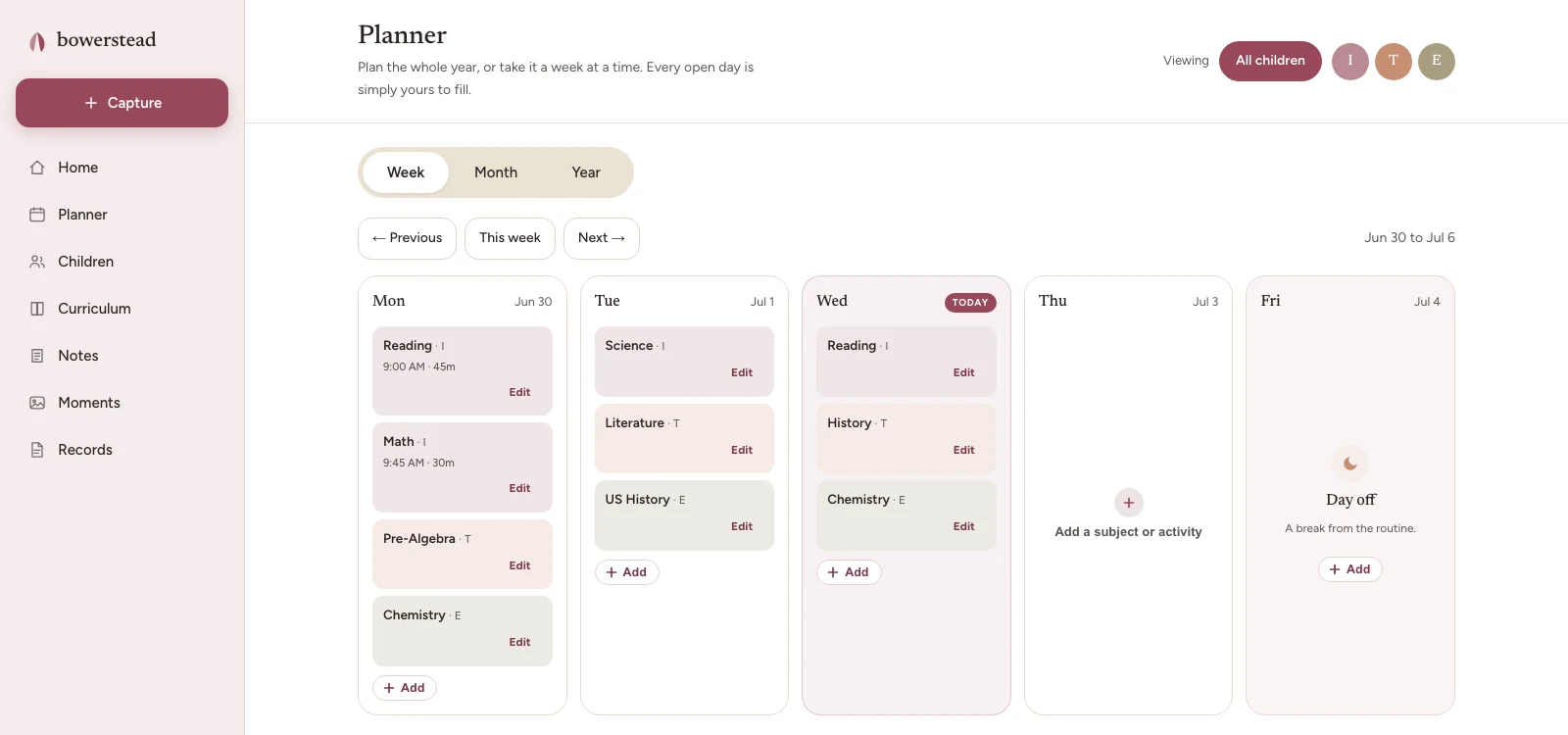
A homeschool planner app is worth its price mostly to this group: note what happened in a few seconds, from wherever you are, and instruction days, subject records and reports assemble themselves. It counts days rather than hours, so check which of the two your state asks for. No streaks and no overdue flags, which matters when the week goes badly. $9 a month or $79 a year, with a 30-day money-back guarantee. Get started.
If you are in the UK
Nothing in elective home education requires a parent to be at home during school hours, and there is no minimum number of hours, no required curriculum and no attendance to record.
Your local authority may make informal enquiries about the education being provided, and a working arrangement is not in itself a concern to them. What they are asking about is whether the education is suitable, which is a question about the provision rather than about your employment.
Frequently asked questions
Can you homeschool and work full time? Yes, and many families do. It is straightforward with children over about twelve, workable with an arrangement for seven to eleven year olds, and hard under seven for supervision reasons rather than teaching ones.
How many hours a day does homeschooling actually take? Roughly one to two hours of focused work for younger children and three to four for high schoolers, and it does not need to happen during the working day.
Can a single parent homeschool while working? Yes, most often by combining early or late instruction with outsourced classes and a supervision arrangement. The constraint is the same one everyone faces, it is just that you are solving it without a second adult, so solve supervision first and build the schedule around the answer.
Do I have to teach during school hours? No state requires instruction to happen between particular clock times. Some count days of instruction and a few count hours, so check what your own state counts and then place those hours wherever they fit.
Is it better to work part time? It removes the hardest constraint, so if it is genuinely available it helps more than any planning technique. It is not a requirement, and framing it as one has talked plenty of families out of something that would have worked.
Free Printable Templates
A four-year transcript and a year-long attendance log, ready to print.
We email you a copy plus occasional record keeping advice. Unsubscribe from any email in one click. See our privacy policy.