Is Homeschooling Hard? What It Is Actually Like
Yes, in the first year, and mostly not in the ways people expect. Teaching the material turns out to be the easy part. What is hard is being with your children all day, losing your own hours, and making a hundred small decisions that nobody made for you. All three ease, and they ease on a fairly predictable schedule. Here is the honest version.
When it is hard, and when it stops
| When | What is hard right then | What ends it |
|---|---|---|
| First month | Everything is a decision. With no defaults yet, choosing when to do math costs as much as teaching it. | Defaults form on their own. By week four most of the day runs without being decided. |
| Months 2 to 4 | Doubt. The curriculum shows its flaws and you assume the flaw is you. | Changing one thing and watching it work. The first correction is what proves corrections are allowed. |
| Months 5 to 9 | Your own time, which is genuinely gone. This is the real cost and it is rarely named. | A fixed block that belongs to you, defended as firmly as a work meeting would be. |
| Year 2 | Much less. The academic side has stopped being frightening. | A year of evidence about how this particular child learns. |
| Later | Adolescence, and teaching subjects past your own level. | The job changes from teaching to arranging, which most parents find easier. |
Why the first year is the whole story
Almost everyone who quits does it in the first year, and almost nobody quits because they could not teach fractions. They quit while carrying the full cost of having no defaults yet, at the exact point before the defaults arrive.
Knowing the shape in advance is worth a surprising amount. A hard October reads completely differently when you were told October would be hard.
What is actually hard
Being together all day
This is the one people underestimate most. School provides seven hours of separation that nobody chose but everybody used, and removing it surfaces every friction in the relationship at once.
It is not a sign the arrangement is wrong. It is the ordinary cost of proximity, and families handle it by building separation back in deliberately: separate rooms for part of the day, an activity that is theirs alone, time when nobody is being taught anything.
Losing your own time
The hours are real and they are gone. Anyone who tells you otherwise is selling something.
The families who last are the ones who treat their own time as a fixed item rather than the slack in the system. A block that is genuinely yours, defended as firmly as you would defend a work meeting, is not indulgence. It is the maintenance schedule for the person doing all of this.
The doubt
There is no report card telling you it is working, so the reassurance that school provides for free has to be manufactured. Most parents underestimate how much they relied on it until it is gone.
The practical answer is evidence. Keep enough of a record that you can look back at October from January and see movement. This is the reason record keeping earns its place long before any state asks for it, and our record keeping guide keeps it deliberately small.
The decisions
Curriculum, timing, order, standards, how much is enough, when to push and when to stop. School answers all of these badly but it does answer them, and the volume of small choices is genuinely tiring in a way that no single choice is.
This is what falls away first. By around week four most of the day is running on habit, and the decision load drops to something ordinary.
What is easier than people expect
- Teaching the material. Curricula are written for parents and explain the content to you as you go. You are learning it one week ahead, which is a perfectly respectable place to teach from.
- The time it takes. One to two hours for a young child, three to four for a high schooler. Most people budget for six and are startled.
- Socializing. It takes arranging rather than luck, but one standing weekly commitment where the same children turn up covers most of it. A co-op is the usual route.
- Subjects past your own level. Online classes, tutors and community college exist precisely here. Nobody teaches their own child calculus by force of will.
- The paperwork. In most states it is a notice and a record of days. Our starting guide has the sequence, and the state guides have the specifics.
What makes it harder than it needs to be
A good share of the difficulty is self-inflicted, which is encouraging, because self-inflicted difficulty is the kind you can put down.
- Recreating school at home. Six hours, a timetable, a room with a whiteboard. This imports every cost of the classroom and none of its reasons, and it is the single most common way a first year becomes miserable.
- Buying too much up front. Expensive materials create an obligation to use them, which is exactly the pressure you do not want in the months when you should be experimenting. Our guide to choosing a curriculum is worth reading before the first purchase.
- Skipping the pause after school. A child who left a bad situation cannot start academics on Monday. Deschooling looks like doing nothing and is doing quite a lot.
- Measuring against a grade level. Grade levels exist to group thirty children of similar age. Applied to one child they mostly generate anxiety, and they will say a perfectly normal child is behind in something.
- Doing it alone. One standing commitment with other homeschooling families is worth more to the parent than to the child, and parents consistently arrange it for the child and then discover this.
Should I homeschool my child?
Nobody can answer this for you, but the question can be made much smaller than it usually is.
Reasons that tend to hold up
A specific problem with a specific child: they are not safe, not learning, not sleeping, or so far ahead or behind that the classroom cannot reach them. A concrete situation you are solving is the most durable reason there is, because you will know whether it worked.
Reasons worth examining first
A general sense that school is bad, without anything specific attached, tends to buckle in the hard months because there is no test for whether things improved. So does starting mainly because someone else is doing it well, and so does homeschooling to avoid a conflict with a school that would be better addressed directly.
None of these are disqualifying. They are worth turning into something specific before you begin, because a vague reason gives you nothing to hold on to in February.
The question that actually decides it
Not whether you are patient enough or qualified enough, both of which are the wrong tests. It is whether you can protect one to two hours on most days for the next year, and whether the adults in the house agree this is happening.
Those two predict outcomes far better than temperament does. If you want a structured comparison rather than a gut check, our homeschool versus public school guide lays both out side by side, and public school wins several of the rows.
What an ordinary day is like
Quieter and shorter than people imagine. Breakfast, an hour or two of focused work in whatever order suits the child, a long stretch of something else entirely, and reading somewhere in there.
There is no bell, no lining up and no waiting, which is why the hours are so much smaller. There are also bad days, and a bad homeschool day is worse than a bad school day because you are inside it rather than collecting a child from it. Both are normal and neither is a verdict.
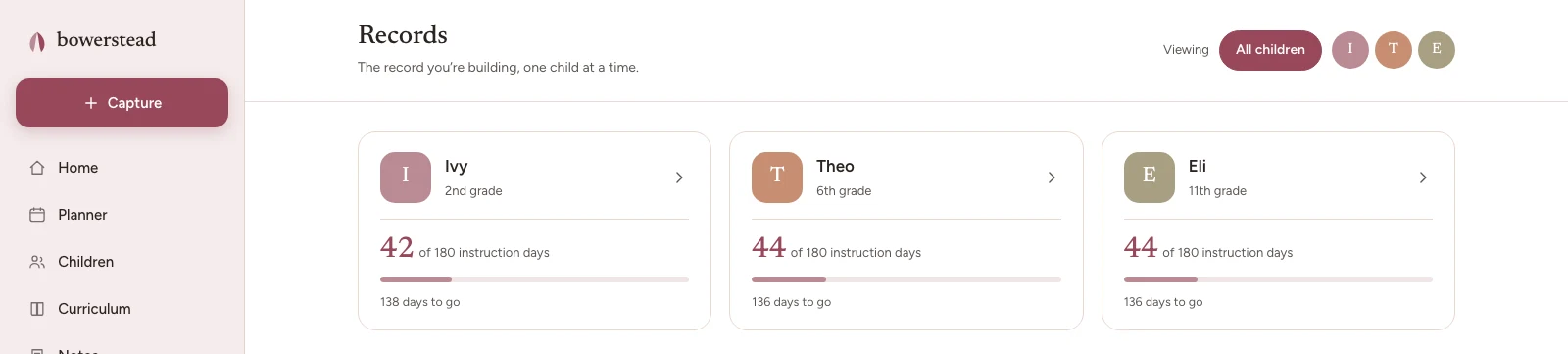
A digital homeschool planner does not make any of the hard parts easier. What it removes is the administrative layer underneath them: note what happened, and instruction days, subject records and reports assemble themselves, which is also where the evidence against the doubt comes from. No streaks and no overdue flags. $9 a month or $79 a year, with a 30-day money-back guarantee. Get started.
If you are in the UK
The emotional shape is identical, and elective home education adds one distinct source of stress: your local authority may make informal enquiries about the education you are providing, and a first letter tends to land much heavier than it is meant to.
Keeping a light record of what you have covered is what turns that exchange into a short reply rather than a week of worry, for the same reason it answers your own doubt.
Frequently asked questions
Is homeschooling hard for the parent? In the first year, yes, mostly because of proximity, lost personal time and decision volume rather than academics. Most families describe the second year as markedly easier.
Am I smart enough to homeschool? Almost certainly. Curricula are written to be taught by a parent, and being a week ahead of your child is a normal and sufficient position. Subjects beyond you get outsourced, which is what everyone does.
What is the hardest part of homeschooling? Most parents say the loss of time alone, followed by the absence of any outside confirmation that it is working. Neither appears on the lists people read before starting.
How do I know if homeschooling is working? Compare your child to themselves three months ago rather than to a grade level. Written records make that comparison possible, and memory reliably makes it worse than it was.
How long before it feels normal? Most families describe the day running on its own by around the second month, and the underlying anxiety taking most of the first year. If you are three weeks in and it feels chaotic, you are exactly where nearly everyone is at three weeks.
Can I stop if it is not working? Yes. Children return to school every year and it is an ordinary administrative process, not a failure. Deciding in advance what you would want to see by a set date makes that judgment much easier to make honestly.
Free Printable Templates
A four-year transcript and a year-long attendance log, ready to print.
We email you a copy plus occasional record keeping advice. Unsubscribe from any email in one click. See our privacy policy.