How to Homeschool in North Carolina: Register Once, Test Every Year
North Carolina is gentler than its reputation in most respects and stricter than most states in one surprising place. You register once with a state agency rather than your school district, you give every child a standardized test each year, and you need a high school diploma or its equivalent yourself. Beyond that there is no subject list, no minimum hours, and no score anyone has to hit. The bigger risk here is not the law. It is what you will read about the law.
You register with a state agency, not your school district
This is the most useful single fact about homeschooling in North Carolina. Oversight belongs to the Division of Non-Public Education, a state office sitting under the Department of Administration rather than the Department of Public Instruction. Your relationship is with one state division, not with a local superintendent, which is the reverse of how Florida and New York work.
You file a Notice of Intent to Establish a Home School through the division’s online portal. It asks for your name as chief administrator, your address, the name you choose for your school, whether you elect a religious or non-religious school, your begin date, and evidence that the administrator holds a high school diploma or GED.
Notices are accepted from July through April during business hours, and take a few business days to process. You cannot open a home school only for the summer, or only to recover a single grade. The filing is one time rather than annual: it opens your school, and the school stays open until you close it, so long as you keep your details current.
Unlike Texas, where nothing is filed and nothing comes back, here you do receive something. The division sends a registration confirmation, and that confirmation is what satisfies compulsory attendance. Save it somewhere you can find it in two years.
What gets repeated about North Carolina, and what is true
More bad information circulates about this state than any other in this series, in both directions. Some of it makes the rules sound far heavier than they are. Some of it promises access and money that simply do not exist. Each correction below traces to the legislature’s own bill history, the statute text, the athletic association’s eligibility policy, or the scholarship authority.
| What gets repeated | What is actually true |
|---|---|
| Senate Bill 48 opened school sports to homeschoolers | It died in the Senate Rules committee in February 2025. It never became law and has no session law number |
| § 115C-566 gives homeschoolers a right to play | That section is about driving eligibility certificates. It has nothing to do with athletics |
| The Opportunity Scholarship helps homeschooling families | It pays private school tuition only. Homeschooling is not an eligible use of it |
| You register with your local school district | You register with the state Division of Non-Public Education, which sits under the Department of Administration |
| You send your test scores in every year | You keep them. They are produced only if the division asks to inspect them |
| North Carolina tells you what to teach | No subject list exists in law. The test covers four areas, and what you teach is otherwise yours |
| Anyone can homeschool here | Almost. The administrator and every instructor need a high school diploma or its equivalent |
Religious or non-religious, and what the election means
Article 39 splits home schools into two parts, at §§ 115C-563 and 115C-564, and you elect one when you file. In practice the requirements are the same either way. The election describes the character of your school rather than putting you under a different set of rules, and neither election is inspected or second guessed.
Two families or households may share a single home school. Grow past two families and you are no longer a home school at all: you are a conventional private school, and you register with the division as one. That threshold catches co-ops that expand without noticing.
What you must teach, and what you need yourself
No subject list is mandated. North Carolina never wrote one, and the only steer toward content comes indirectly through the annual test.
There is a calendar requirement instead. Your school operates on a regular schedule for at least nine calendar months of the year, with reasonable vacations and holidays allowed. No minimum hours per day sit underneath that, so the nine months describes the shape of your year rather than the length of your day. If you start mid-year, you document instruction across nine months of that academic year, counting the time the child spent in a traditional school.
And North Carolina is one of the few states that asks something of the parent. The chief administrator and every instructor in the household must hold at least a high school diploma or its equivalent. No degree, no teaching credential, and no subject expertise, but the diploma or GED is a genuine requirement rather than a recommendation.
The annual test
Every enrolled student takes a nationally standardized or nationally normed achievement test once a year, covering at least English grammar, reading, spelling and mathematics. The Iowa, Stanford and California tests are the usual choices. The first one falls within your first academic year of operation, and then it is annual.
Two details save families trouble. North Carolina’s public End-of-Grade tests do not satisfy this, so a child who sat those before withdrawing still needs a qualifying test. And you may administer the test yourself if the publisher permits it, which many do, so this need not mean a testing center and a stranger.
There is no minimum score. There is no state remediation process, no probationary year, and no mechanism by which a low result stops you homeschooling. The requirement is that the test happens and the result is kept, not that the result reaches a bar. That is a meaningfully lighter arrangement than it sounds like when you first read the word testing.
The records you keep, and do not send
Three things: the annual test results, attendance records, and immunization records or a valid religious or medical exemption.
You retain all of it. Nothing is submitted automatically, and the division’s inspection power is narrow, reaching test records at reasonable times. Test results are kept at your school’s principal office, meaning your home, for at least a year, and the division recommends keeping attendance and immunization records permanently.
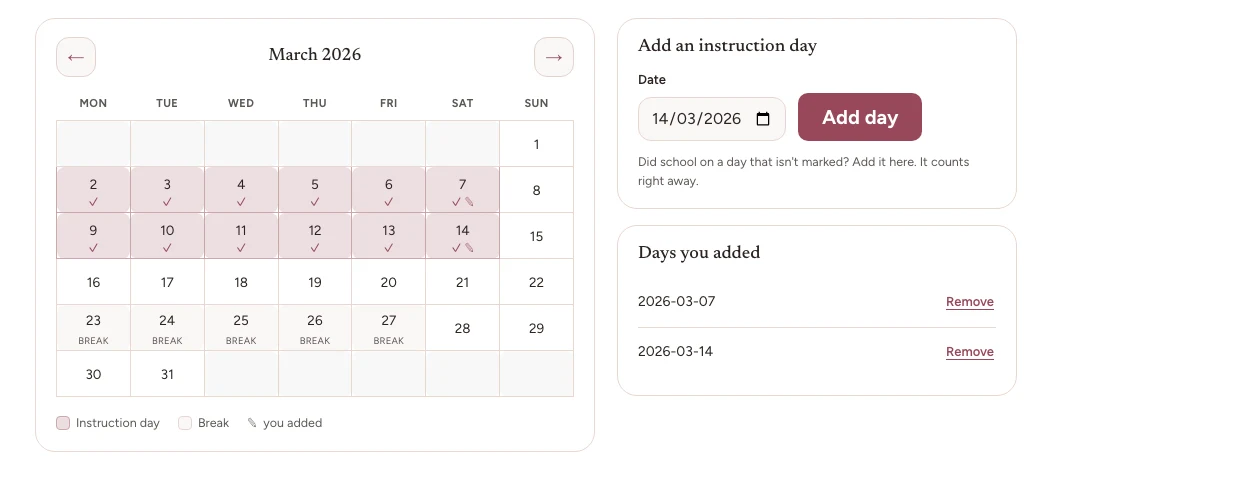
Attendance is the one that quietly costs people. It is a legal requirement here rather than a good habit, it has to exist across nine months, and it is close to impossible to reconstruct honestly in arrears. An electronic homeschool planner records the day as it happens, keeps the subject and lesson detail alongside it, and assembles a transcript from the same entries when high school arrives. $9 a month or $79 a year, with a 30-day money-back guarantee. Get started. If you would rather run it on paper, our guide to homeschool record keeping covers what to keep and for how long.
The Opportunity Scholarship is not for you. ESA+ might be
This is the most expensive misunderstanding in North Carolina. The Opportunity Scholarship is the state’s large and well publicized program, and the General Assembly removed its income cap so that it is now open to families at any income. It pays private school tuition, directly to registered private schools. It cannot be used to homeschool, and eligibility has never turned on how much you earn.
What does reach homeschooling families is ESA+, the disability based account administered by the state education assistance authority. It requires an eligibility determination from a North Carolina public school. The base award is $9,000, and certain designated disabilities qualify for substantially more. It covers therapy, tutoring, technology and specialized curricula as well as tuition.
Taking ESA+ does not change what you legally are. You remain a registered home school, and you take on the authority’s spending and reporting rules on top of your existing obligations. Proposals to extend a direct homeschool grant under the Opportunity Scholarship have been introduced in the past, so it is worth checking the current position rather than relying on either a guide or a memory of one. Our guide to homeschool funding sets this against what other states offer.
Sports, part time classes and dual enrollment
There is no statutory right to public school sports in North Carolina, and this is where the misinformation does real damage, because families plan around access they do not have.
The athletic association requires a player to be a regularly enrolled member of the school’s student body, which for a homeschooled student means continuous dual enrollment under the association’s own policy, and local boards are not obliged to offer that. Some do, many do not. The practical answer most families reach is the homeschool athletic leagues run by the state homeschool association, which are well established and do not depend on a district saying yes.
Part time enrollment in a public school is likewise not mandated. A bill that would have required it died in committee, so it remains a local board decision and varies district to district. Dual enrollment, however, works: the state virtual public school accepts homeschool students on a paying basis, and community colleges run dual enrollment through Career and College Promise.
Leaving public school
Compulsory school age here runs from 7 to 16. A child under 7 can simply be withdrawn, with no notice of intent needed first, which surprises parents of kindergarten age children.
For a child already enrolled, there is no legal requirement to notify the school of your intent to homeschool. Notify them anyway, in writing, and register with the division. Once your registration is confirmed, compulsory attendance is satisfied, and a short written note to the school closes the loop so that nobody generates an absence problem out of an administrative gap.
High school, transcripts and special education
You design, hold and issue everything. The administrator maintains the transcript, merges in community college coursework, and issues the diploma. The division issues no transcripts and no diplomas, and does not validate yours. The University of North Carolina system evaluates homeschool applicants against the same admission standards as anyone else.
Because nothing is issued to you, the transcript is entirely your artifact, and it wants starting in ninth grade rather than being assembled in twelfth.
On special education, be careful. A home school operates as a non-public school, so the district’s obligation to provide a free appropriate public education does not follow your child out. North Carolina also has no clearly published entitlement to continued district services for home school students, which makes it weaker on this point than several other states. ESA+ is the main funded route. Ask your district directly what it will and will not do rather than assuming either way.
The mistake that causes almost all the trouble
It is believing something that is not true, and the direction varies. Families talk themselves out of homeschooling in North Carolina because they have read that the rules are heavy, when there is no subject list, no minimum hours, no score to hit and nothing to submit. Other families plan a year around Opportunity Scholarship money or a sports season that was never available to them.
The fix is the same in both directions. For anything that matters, check the division’s own pages, the statute, or the athletic association, rather than a blog post that does not date its information. New to all of this? Our guide to how to start homeschooling takes over from here, and Texas is worth a look if you want to see how differently two states can approach the same question.
Statutes, award amounts, filing windows and athletic policies all change, and bills are reintroduced from session to session. Confirm the current detail with the Division of Non-Public Education, the state education assistance authority, or a homeschool legal organization before you act on it. This guide describes the shape of North Carolina law as of July 2026, not the paperwork of any particular year.
Frequently asked questions
Do I have to register to homeschool in North Carolina? Yes, but with the state Division of Non-Public Education rather than your school district. It is a one time online Notice of Intent, and you receive a registration confirmation that satisfies compulsory attendance.
Do I need a diploma or degree to homeschool in North Carolina? A high school diploma or its equivalent, yes, for the chief administrator and for every instructor in the household. No college degree and no teaching credential are required.
Do North Carolina homeschoolers have to take standardized tests? Yes, once a year, covering at least English grammar, reading, spelling and mathematics. There is no minimum score and no consequence for a low one, you keep the results rather than submitting them, and you may often administer the test yourself.
Can homeschoolers use the North Carolina Opportunity Scholarship? No. It funds private school tuition only. The disability based ESA+ is the program that reaches homeschooling families.
Can homeschoolers play public school sports in North Carolina? There is no statutory right to it. Access depends on continuous dual enrollment that local boards are not required to offer, and most families use the homeschool athletic leagues instead. Claims that a 2025 bill changed this are wrong: it died in committee.
Free Printable Templates
A four-year transcript and a year-long attendance log, ready to print.
We email you a copy plus occasional record keeping advice. Unsubscribe from any email in one click. See our privacy policy.